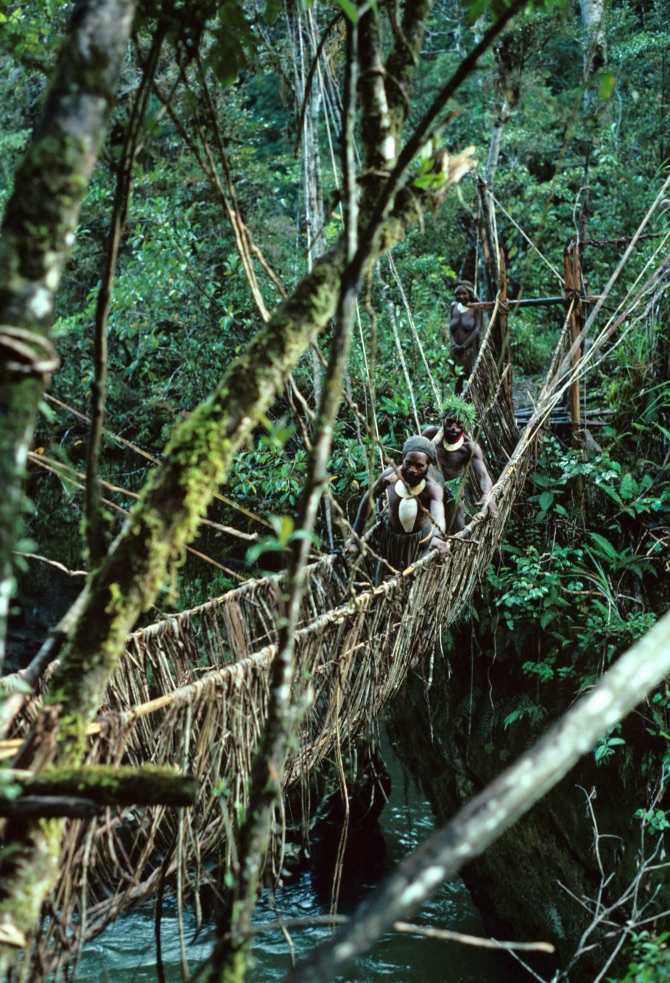
BUILT IN NIUGINI: CONSTRUCTIONS IN THE HIGHLANDS OF NEW GUINEA
BUILT IN NIUGINI: CONSTRUCTIONS IN THE HIGHLANDS OF NEW GUINEA
The book builds on my previous publications dealing with aspects of Was valley life, which have prepared the way to address the issues discussed in this one. In particular, this study of fixed capital assets is a companion to my earlier book Made in Niugini (Sillitoe 1988) that deals with movable capital. It completes my investigation of Was valley material life, exploring the construction activities omitted from that work on material culture. The intention initially was that it would be a part of that volume, which, with its focus on artefacts, astutely foresaw a renewal of interest in material culture studies, although it was wide of the mark, until recently anyway, in assuming that this would include a focus on technology. This book continues to argue for attention to technology — in the context, for instance, of current interests in so-called materiality — and seeks to show what we can achieve by situating in-depth technological enquiry within wide socio-cultural context. In this way it delves into topical issues pertaining to material issues, which are central to the domain marked out as the ‘economy’, and feature prominently in topical debates about the sociology of knowledge.
The book is a further contribution to my broadly framed study of an ‘economy’ in the New Guinea highlands, so far as that category applies where people have no word equivalent to ‘economy’ or mention related ideas (Sillitoe 2010). Consequently, I inevitably define some of the problems in the enquiry (as the postmodern critique affirms) and draw on my culture’s concepts in seeking answers. Being a study of property, it concerns the economy minimally defined, as activity relating to the material means of existence. But Was valley residents’ fixed property relations illustrate the incongruity of economic assumptions, having no idea of private and public property but rather one of restricted common property. The builders of a house, for example, may construct it on almost any land in locales where they have active social relations with others, and while they enjoy prior rights of residence, other relatives or friends may live there too (so long as they are on good terms with other occupants). And the residents’ have priority rights to occupy the site so long as they continue to maintain a house there. Similarly, labour arrangements queer the relevance of economic assumptions with a sexual division of labour structuring activities such as house building in a way that subverts market approaches to work, whether capitalist or socialist. These arrangements are integral to the independence of households, which as autarkic productive bodies render mercantile considerations peripheral – that is, they do not involve interactions of the sort that afford some actors elsewhere hierarchical control of production and transaction, who use the ensuing power to govern the lives of others, which is the antithesis of egalitarian relations and an acephalous order.
The argument draws on archaeology, which has long had an interest in technological issues. It explores in more depth relations between anthropology and archaeology, mentioned tentatively in my earlier companion volume on artefacts, and how their integrated study of technological and material issues may advance understanding of tacit aspects of knowledge, however improbable at first sight. While archaeologists have expended much effort in understanding buildings — the remains, largely foundations, of which comprise a significant part of the evidence of past lives — anthropologists have not taken such interest in them, which is strange as the building of shelters of various kinds, from igloos to skyscrapers, is one of the few universal cultural features of humankind. The gap is plainly evident, for instance, in New Guinea where information on construction activities such as house building is scarce relative to other topics, such as exchange, marriage and initiation. It has fallen to vernacular architecture to fill the gap in part, albeit it approaches the many different construction practices and designs around the world by and large from a narrow architectural perspective. In this context, the book is a contribution to the local architecture literature, seeking to show how situating the study of construction activities with respect to wider issues, socially, culturally and intellectually, can further understanding.
The book’s focus on building and the doing of practical tasks directs attention to experiential knowledge issues. We engage in many activities without being intentionally aware of doing so, about which we apparently know nothing consciously. We undertake practical tasks such as hammering in a nail without thinking about the act itself, our attention focussed on hitting the nail not holding and wielding the hammer; the tool in a sense becoming an extension of our arm. And we likewise follow social conventions automatically without reflection when we interact with other persons, such as shaking hands when we meet or seating ourselves in chairs. Our minds are elsewhere, often engrossed in conversations, during which we talk without deliberating about grammar and the meaning of words. These everyday acts and things, which are intuitively familiar, do not necessarily involve mindful thought. Such being is a pre-reflective state, informed by socio-cultural inculcation and experience. The way we are in the world, as phenomenology puts it, presents them to us. The implications for what we think we know about human behaviour are profound.
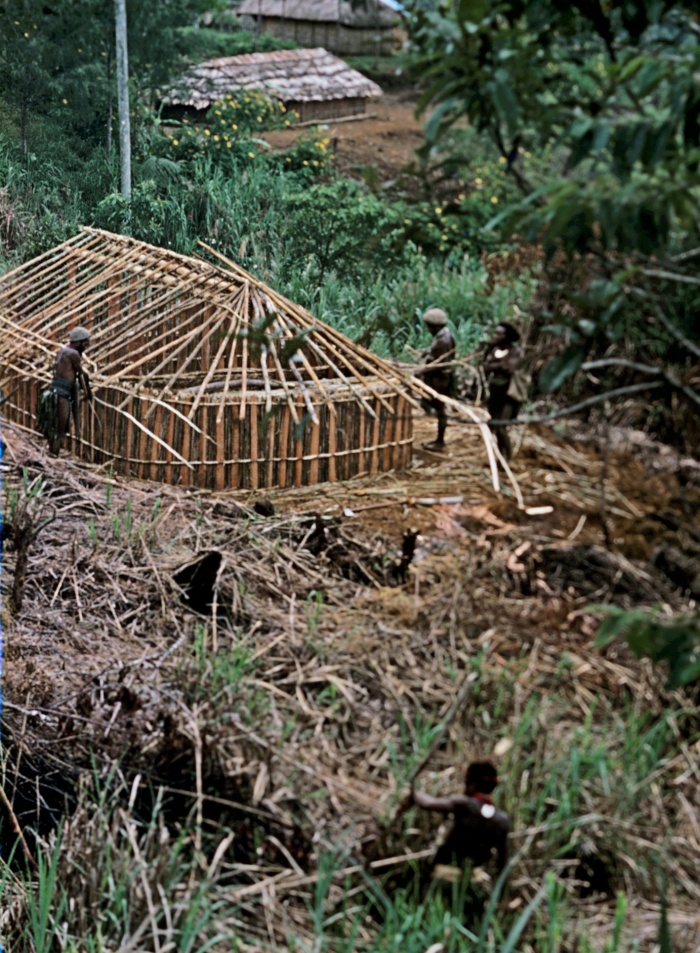
The book uses an in-depth ethnographic study of building practices in the New Guinea highlands as a vehicle to explore these issues. It affords an opportunity to found discussion of these elusive matters in a determinate context, mindful of the distinction made by the Enlightenment philosopher David Hume between the ‘passions’ that we perceive first-hand as ‘impressions’ or sensations and ‘reason’ that deals second-hand with these as ideas or mental representations. We know the passions empirically through experience and observation, whereas ideas are abstractions that represent something beyond themselves, namely the sense impressions that they signify. It is a distinction elaborated on subsequently in debates pitting empiricists against idealists. One side demands first-order evidence of phenomena, someone/ thing that we can see, touch, hear, smell etc. — such as a person sitting in a room doing something — to which we can refer in our discussions and compare our ideas whatever our socio-cultural background (assuming that all humans have the same senses). The other side gives precedence to broad culturally relative abstractions – such as the idea of society for a group of socially interacting human beings – for which we have no empirical sense derived evidence and which afford no concrete referent as intangible ideas (I cannot put my idea of English society in a room to investigate it further).
The second order intellectual constructs concern abstract categories that are particularly difficult to access, translate and correlate cross-culturally, relating to concepts that are socio-historically informed and subject to wide cultural-linguistic variation. Yet discussions of contentious, conscious ‘know not’, tacit or experiential issues in the social sciences, currently in so-called practice or agent theories, depend on such elusive second order abstractions in enquiring into the taken-for-granted values, responsibilities and obligations that inform the behaviour of persons socialised to hold these in common. My aim in this book is to direct discussion onto tangible first order things, using the study of material constructions to further understanding of intellectual constructions, on the grounds that it affords us an opportunity more securely to investigate the significant implicit dimensions of human behaviour. The dependence of much materially related knowledge — like other domains of knowledge — on tacit understandings helps pose several questions regarding what we can aspire to know. We can rigorously examine the material aspects of life, in the empiricist tradition, as they involve senses-detectable phenomena ‘out there’ against which we can test the veracity of arguments; unlike ideological issues, in the metaphysical tradition, favoured by many social theorists.
The individual character of experiential knowledge further affords an opportunity to enquire substantively into the variability that characterizes human behaviour. The social sciences are only now facing up to the implications of individual behavioural variation with the move from a structural to a processual focus, challenging assumptions about homogenous normative codes guiding social interaction, which have persons in the same social group sharing identical concepts, values etc. It relates to the individual perspective that I controversially argue is prominent in Was valley behaviour, albeit set within a matrix of quite different, even opposed, cultural assumptions to those of Western individualism. My idea of the Melanesian individual is a composite of Dumont’s “indivisible sample of mankind” and a “culturally constituted moral entity”. The book explores this view of individuality further with respect to personal experience, which includes the implicit contexts of involuntary ‘emotions’ that are central to human social responses. Living in a stateless polity, the Wola emphasize individual autonomy and equality, way beyond that expected in centralized states. My work seeks to understand how the social order can extend such freedom of action without anarchy. Gender relations are a key issue here, explored in this book in the context of housing arrangements and sexual division of labour.
This materially focused discussion of tacit knowledge also affords an opportunity to illustrate and discuss the connotations of what I have cheekily dubbed ethno-determinism, not only drawing on the classic ethnographic approach to enquiries but also currently in vogue phenomenological philosophy. The ethno-det’istic perspective prioritises lines of enquiry that emerge from the ethnography and stresses the significance of evidence, limiting interpretations-cum-explanations of behaviour that depend overly on researchers’ imaginations. It does not deny that we inevitably deploy a certain explanatory or interpretative framework to guide selection of what to include in any enquiry and how to make sense of it; but it advocates theoretical heterogeneity and flexibility in this respect, seeking to accommodate the idiosyncrasies of various cultural ways and uncertainties of social life. The study of construction activities affords, what at first may appear an improbable opportunity, to explore the philosophical underpinnings of the ethno-det’ist approach and show that it is serious about both ethnography and theory-cum-ideology, in addressing deep intellectual questions in incisive ways from different cultural directions. In short, the book is not just about building houses but also about building understanding of the limits of our comprehension of other ways of being in the world, or to use the currently popular idiom, other ontologies.
- 1988 Made in Niugini : technology in the highlands of Papua New Guinea. London: British Museum Publications and [1989] Bathurst: Crawford House Press.
- 2010 From land to mouth: the agricultural ‘economy’ of the Wola of the New Guinea Highlands. New Haven: Yale University Press